 FREE SHIPPING £75+
 CELEBRATING 50+ YEARS
 PRICE MATCH GUARANTEE


Conducted RF immunity testing normally depends on a calibrated signal source, power measurement and a suitable coupling device. EMCview PRO brings those controls into one workflow, allowing engineers to automate useful EN 61000-4-6 and ISO 11452-4 pre-compliance checks with CDNs or bulk current injection probes.
The immunity features were introduced in EMCview PRO version 8.42 and continue in the current software. Telonic’s current product listing identifies version 9.0 as the latest release.
Pre-compliance note: the setups in this article are simplified engineering tools. They do not replace the applicable standard, an accredited laboratory or the detailed cable layout, grounding, auxiliary-equipment and calibration requirements in an approved test plan.
What EMCview PRO controls
EMCview PRO coordinates the source level, calibration sweep, correction data and immunity run. A spectrum analyser with a tracking generator can provide both the swept RF source and the measurement receiver, keeping the setup accessible for development work. The optional signal-generator support provides finer amplitude control and avoids some of the stepping behaviour associated with tracking generators.
Tracking-generator setup
Uses zero-span operation at each frequency point. It is cost-effective, but output range, 1 dB amplitude steps and switching glitches must be understood.
RF signal-generator setup
Offers more accurate level control and cleaner frequency changes. EMCview’s SG option supports selected Rigol, Siglent and UNI-T generators.
Modulated amplifier
Tekbox amplifiers can supply built-in 1 kHz, 80% AM and pulse-modulation modes when the source only provides CW.
Calibration file
Stores the source level or forward power needed at each frequency, compensating for the response of the source, amplifier and coupling network.
Modulation and power headroom
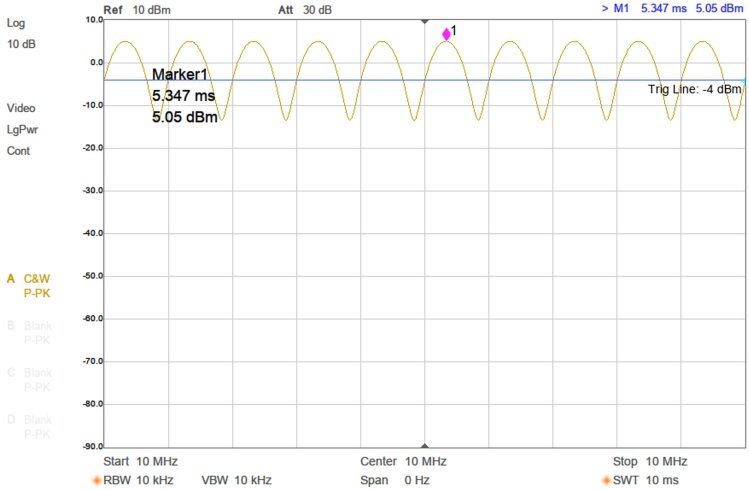
Conducted-immunity standards commonly call for a modulated disturbance rather than a plain CW carrier. With 1 kHz, 80% AM, the peak envelope is approximately 5.1 dB above the unmodulated carrier. The amplifier therefore needs enough headroom to reproduce the envelope without clipping.
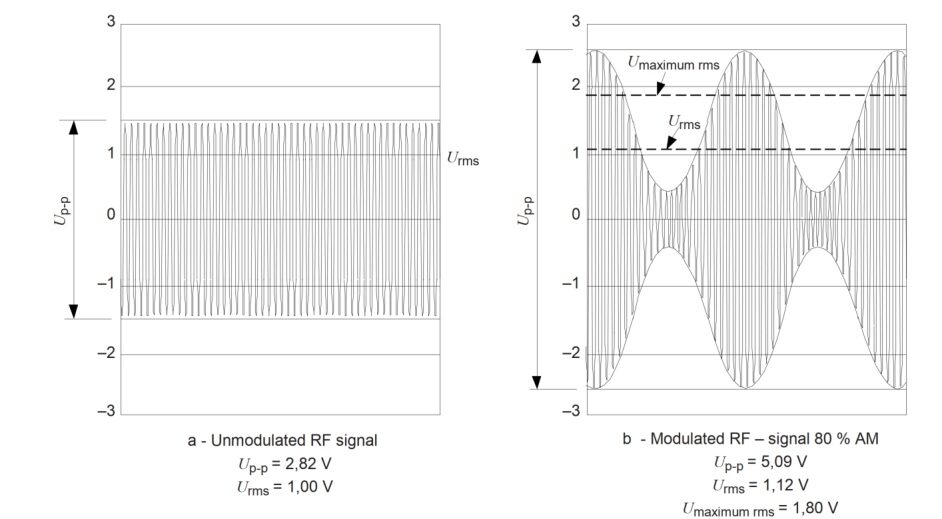
In the arrangement described by Tekbox, calibration is carried out with CW. When the internal modulator is enabled, the carrier is reduced by approximately 5.5 dB to preserve headroom. EMCview also accounts for the 1.1 dB contribution of the AM sidebands when calculating the calibration target.
The basic two-stage workflow
- Calibrate the empty test path. EMCview adjusts the source level at each frequency until the required stress is measured, then stores the result in a calibration file.
- Connect the EUT and run the immunity sweep. EMCview recalls the calibration data, applies the required modulation and steps through the configured frequency range.
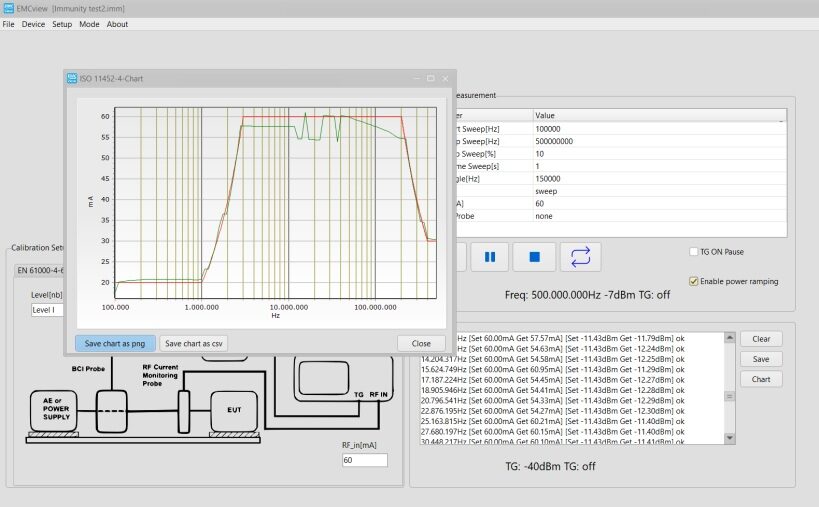
If the requested level cannot be reached, EMCview records the closest available setting and displays a warning. That makes the shortfall visible, but it does not make the point compliant. The result should be treated as a reduced-stress investigation.
EN 61000-4-6 testing with a CDN
A coupling/decoupling network is normally the preferred EN 61000-4-6 injection method when a suitable CDN exists for the EUT cable. It provides controlled common-mode coupling and uses RF power efficiently.
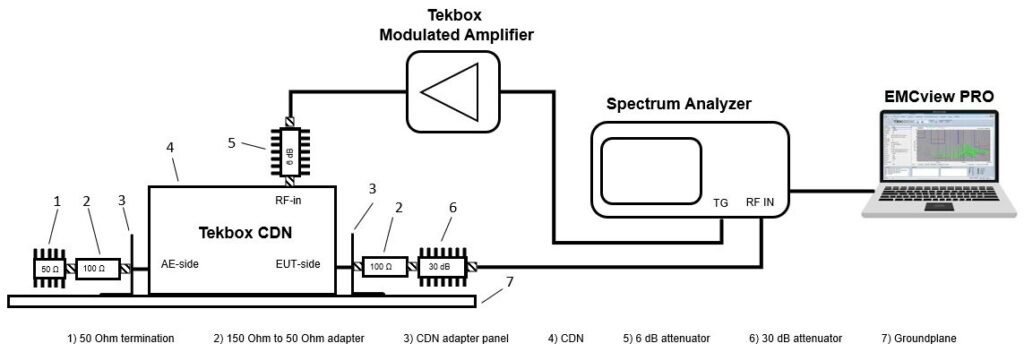
The calibration calculator uses the selected stress level and the actual attenuation at the analyser input to determine the measurement target. The software then sweeps the configured frequency points and stores the required source level. Entering the attenuator value correctly is essential; a wrong value moves the entire calibration.
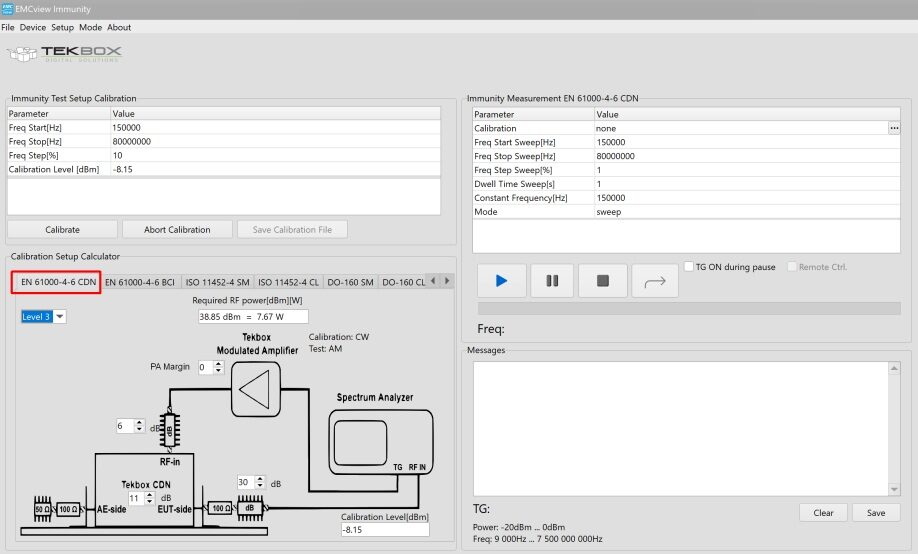
For CDN work, Tekbox recommends the TBMDA-CDN25 as the higher-power option in its compact pre-compliance range. The source note calculates that approximately 7.6 W may be required at the amplifier output for a nominal Level 3 setup with the stated losses. Real requirements depend on the full calibrated path.
EN 61000-4-6 testing with a BCI probe
Bulk current injection is useful when a suitable CDN is unavailable or when the disturbance needs to be coupled into a cable bundle. It is generally less power-efficient because the required amplifier output depends heavily on probe coupling loss.
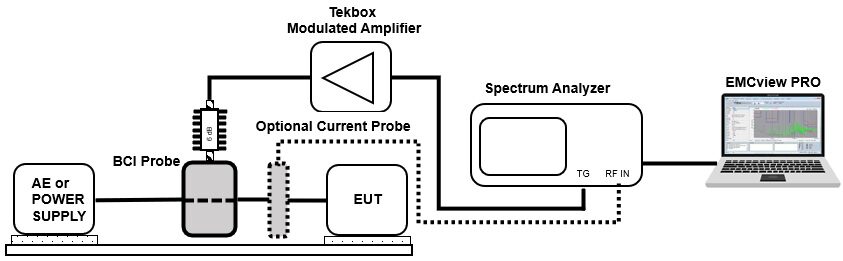
An optional current-monitoring probe can show the injected current during the run. EMCview requires the corresponding transimpedance correction file so that the measured RF level is converted into current correctly.
ISO 11452-4 BCI: substitution or closed loop?
| Method | How the level is established | Practical advantage | Important limitation |
|---|---|---|---|
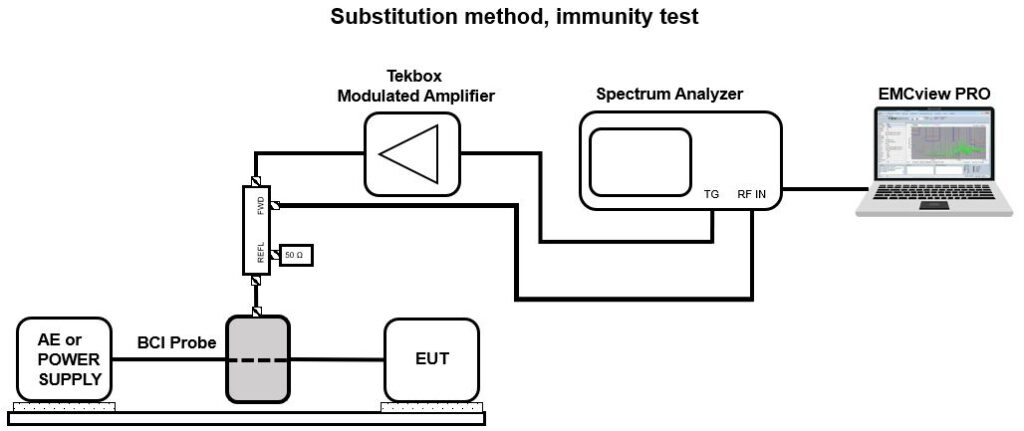
| Substitution | A calibration fixture establishes the drive and forward power required for the target current before the EUT is connected. | Produces a repeatable forward-power profile for the subsequent test. | The actual current in the EUT cable can differ from the fixture result. |
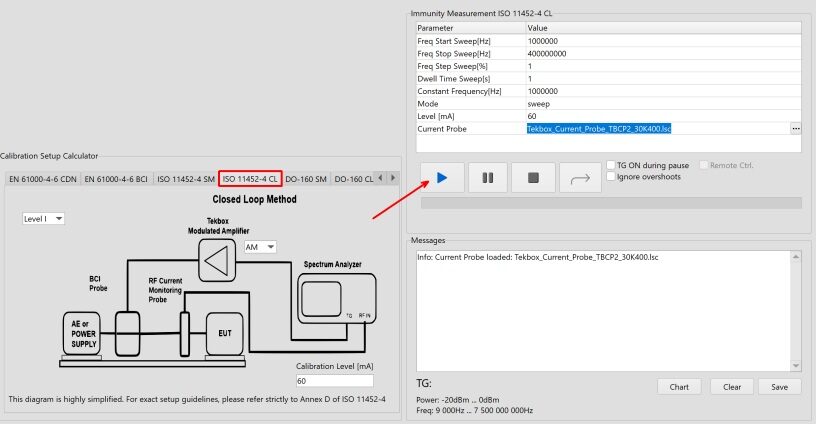
| Closed loop | A monitoring probe measures the current during the EUT test and the source is adjusted continuously. | Shows the actual injected current across the sweep. | High cable impedance or resonances can demand more power than the amplifier can supply. |
Substitution method
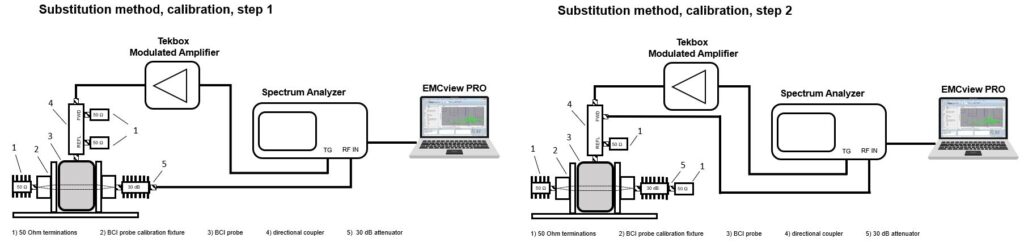
EMCview uses a two-part calibration. The first step adjusts the source to achieve the selected current in the calibration fixture. The second step measures the equivalent forward power through the directional coupler or VSWR bridge. The saved file therefore maps the forward power required at every frequency.
Closed-loop method
Closed-loop levelling measures the injected current while the EUT is connected. EMCview adjusts the drive at each point to reach the target, subject to the available amplifier power and the impedance of the cable/EUT arrangement.
Warnings that should not be ignored
- TG level too low: the amplifier cannot deliver the requested stress at that frequency. Use the result only as a reduced-level investigation.
- TG level too high: the source cannot reduce its output far enough. An external attenuator or a separate lower-level band may be required.
- Frequency-step glitches: some tracking generators briefly jump or drop in level while changing frequency.
- Amplifier saturation: allow practical margin rather than assuming saturated output is equivalent to linear operation.
- Harmonic responses: cost-effective modulated amplifiers may not meet the harmonic suppression expected from a full compliance system. Repeated failures at integer-related frequencies deserve investigation.
- Unavailable closed-loop current: document the actual current trace rather than reporting the unattained target.
Choosing the main hardware
- CDN testing: normally the most efficient option for EN 61000-4-6 when the cable type can be matched to a suitable CDN.
- BCI development work: useful for cable bundles and configurations without a suitable CDN, but allow for greater amplifier power.
- TBMDA-CDN25: a 25 W, 100 kHz to 250 MHz amplifier intended for CDN and lower-power BCI pre-compliance work.
- TBMDA-BCI100: a higher-power 1 MHz to 400 MHz option designed for ISO 11452-4 BCI testing, with reduced-power operation available below 1 MHz.
- Source choice: a compatible spectrum analyser with tracking generator minimises equipment count; a supported RF signal generator improves level resolution and frequency transitions.
The value of an immunity pre-compliance setup is not simply reaching a number. It is knowing the actual stress delivered at each frequency, recording any shortfall, and correlating repeatable EUT behaviour with the calibrated RF path.
Recommended software and amplifiers
These products match the main workflows described in this article. Use the category links for the remaining coupling devices, probes, analysers and signal sources.
-

TEKBOX TBMDA-CDN25 MODULATED WIDEBAND POWER AMPLIFIER
£2,519.00 (£3,022.80 inc. VAT)Available on back-order
Availability: Stock models delivered next working day (UK only) for orders placed before 16:30 (Mon - Fri)
Add to basket -
TEKBOX EMCview Pro PC Software Licence
£653.00 (£783.60 inc. VAT)Available on back-order
Availability: Stock models delivered next working day (UK only) for orders placed before 16:30 (Mon - Fri)
Add to basket -

Tekbox TBMDA-BCI100 modulated wideband power amplifier 100W 1 MHz – 400 MHz
£3,543.00 (£4,251.60 inc. VAT)Available on back-order
Availability: Stock models delivered next working day (UK only) for orders placed before 16:30 (Mon - Fri)
Add to basket
Need the complete technical detail? The full Tekbox application note includes the calculation tables, amplifier capability guidance and step-by-step setup screens for each test method.
Source acknowledgement: method and figures adapted from the Tekbox application note “EMCview Immunity Tests”, version 1.0. Always use the applicable edition of EN 61000-4-6 or ISO 11452-4 and the relevant product test plan for authoritative requirements.