 FREE SHIPPING £75+
 CELEBRATING 50+ YEARS
 PRICE MATCH GUARANTEE


This updated case study uses a legacy GSM handset to demonstrate a still-relevant measurement method: correlate analogue baseband activity, radio state changes and supply current on one timebase. The cellular technology is historical, but the workflow applies to modern radios, wireless sensors and battery-powered embedded products.
Treat the handset and its measured values as the worked example, not as a current product recommendation. The reusable lesson is multi-domain correlation.
Signals in the original experiment
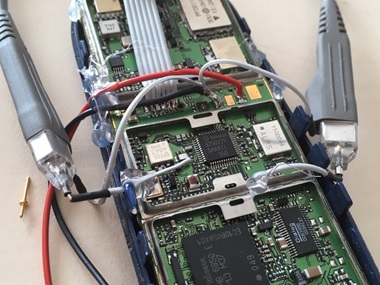
Transmit baseband
An analogue I/Q path revealed when the transmitter became active and how burst data changed.
Receive baseband
A second analogue channel showed paging, neighbour-cell checks and received bursts.
Supply current
A shunt measurement exposed processing and transmitter current demand on the same timebase.
Protocol state
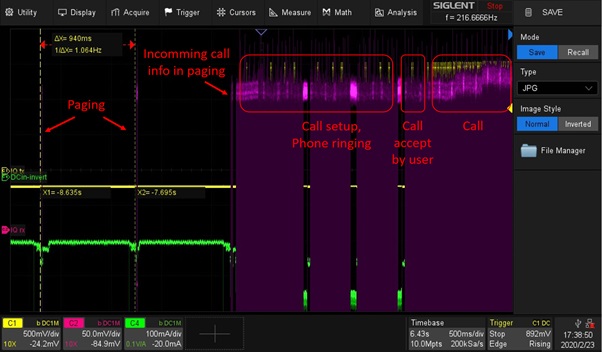
Persistence, zone triggering and deep memory separated idle, paging, call setup and active-call behaviour.
Why simultaneous capture matters
A radio event may last only a fraction of the overall duty cycle. A DMM can report average current while missing the peak. A protocol view can show valid traffic without revealing supply collapse or delayed firmware response. Capturing analogue activity and current together links the state transition to its electrical cost.
Recreate the method safely
- Use available documentation and verify the probe points before powering the device.
- Choose a shunt value that produces useful voltage without causing unacceptable burden voltage.
- Use a differential measurement where neither side of the shunt is safely earth referenced.
- Start with conservative bandwidth and probe attenuation, then increase bandwidth only when the event requires it.
- Trigger on a current threshold, zone, radio-control edge or decoded bus event that uniquely identifies the state.
- Use persistence for repeated timing patterns and long memory for infrequent activity.
What to extract from the acquisition
Peak current
Size the supply path for the highest credible burst, not only the average.
Charge per event
Integrate current over the event to compare firmware and radio configurations.
Duty cycle
Measure how often paging, scanning, connection and retry events occur.
Latency
Measure the delay between control activity, radio response and application behaviour.
Applying the workflow to current products
For BLE, Wi-Fi, LoRa or other radios, substitute signals that expose the state machine: enable lines, SPI transactions, interrupt pins, RF detector outputs or firmware markers. The oscilloscope does not replace a protocol or vector-signal analyser; it explains when electrical events occur and how they relate to the embedded system.
Recommended instruments
-
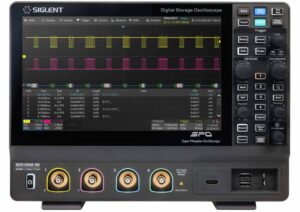
Siglent SDS1104X HD 4Ch, 100MHz, 2GSa/s, 12 Bit, HD high resolution oscilloscope
£926.00 (£1,111.20 inc. VAT)2 in stock (can be backordered)
Availability: Stock models delivered next working day (UK only) for orders placed before 16:30 (Mon - Fri)
Add to basket
-
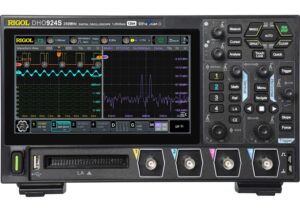
Rigol DHO914 4CH, 12Bit, 125MHz, 1.25GSa/s Digital Oscilloscope
£501.00 (£601.20 inc. VAT)Available on back-order
Availability: Stock models delivered next working day (UK only) for orders placed before 16:30 (Mon - Fri)
Add to basket
-
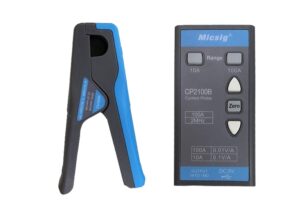
Micsig CP2100B AC/DC Current Probe
£430.00 (£516.00 inc. VAT)5+ In UK Stock
Availability: Stock models delivered next working day (UK only) for orders placed before 16:30 (Mon - Fri)
Add to basket