
 FREE SHIPPING £75+
 CELEBRATING 50+ YEARS
 PRICE MATCH GUARANTEE
New from SIGLENT · November 2026
Four new tools for the field, the bench and the test system
Explore the SHA865A handheld signal analyser, SDM4075A precision multimeter, SYN64-R synchronisation distributor and SAP1000H differential probe.
A field interference investigation, a small change in a precision measurement, a multi-instrument trigger system and a fast differential waveform each need a different approach. These four additions to the SIGLENT range address those tasks with dedicated measurement and test-system capabilities.
Telonic is introducing four additions to its SIGLENT range. Here is a closer look at the measurements they support and the configuration details to consider when selecting the right instrument or accessory.
SHA865A: 26.5 GHz analysis beyond the bench
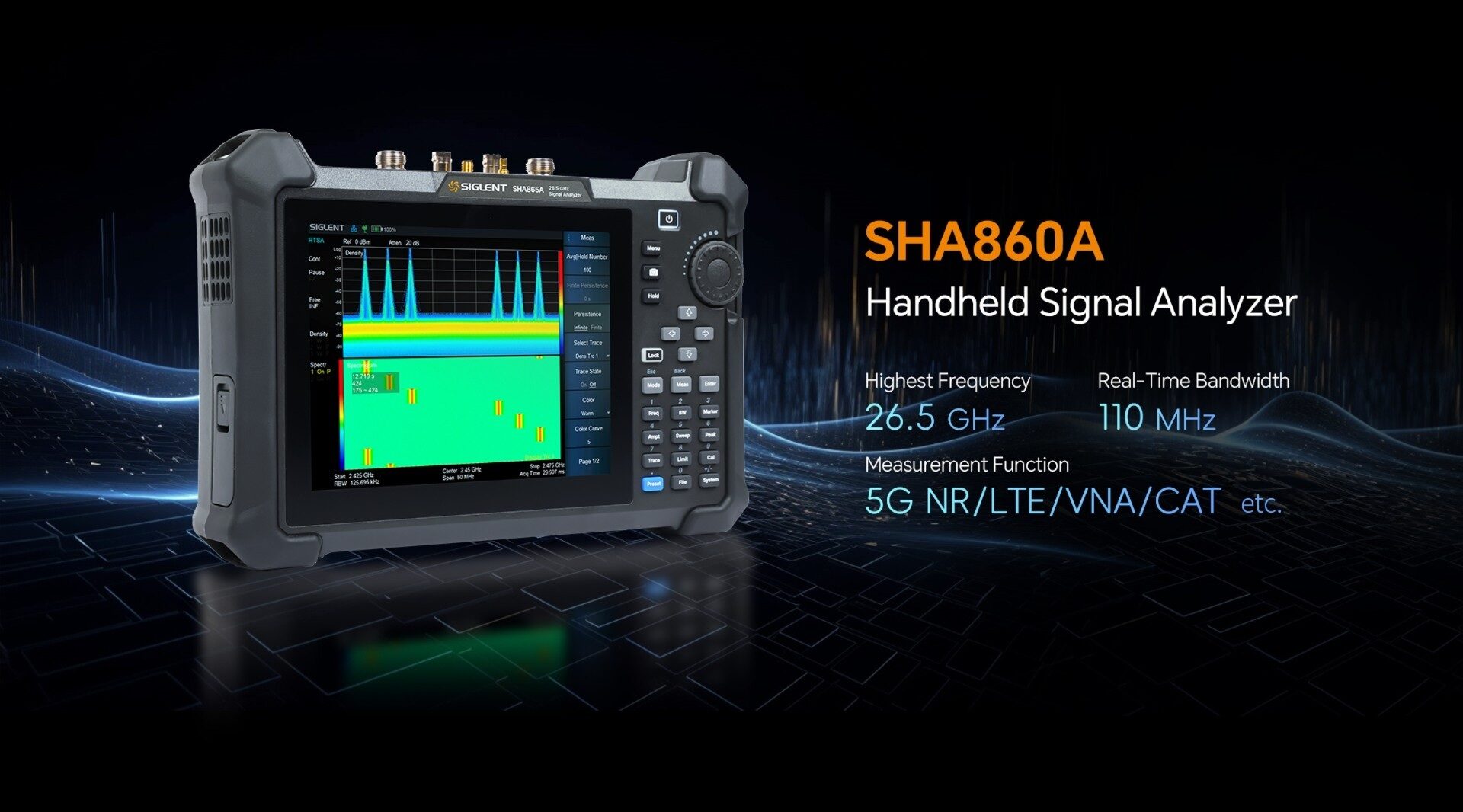
RF installation and troubleshooting often take place away from a conventional bench. The SHA865A brings spectrum analysis from 9 kHz to 26.5 GHz into a handheld instrument, making it a practical option for engineers investigating interference, checking RF systems and working on site.
It is the 26.5 GHz model in the SHA860A family. Its 8.4-inch touchscreen, approximately 3.5 kg net weight and typical 2.5-hour battery operation support work where portability matters. The instrument can then be configured around the measurements the job requires.
For intermittent signals, the optional real-time spectrum analysis function helps reveal activity that may be missed during a conventional sweep. The platform provides 40 MHz analysis bandwidth as standard, extendable to 110 MHz with the B1A bandwidth option. Real-time analysis itself requires the RTA option.
Other available options include 5G NR and LTE over-the-air measurements, cable and antenna testing, one-path two-port vector network analysis, IQ acquisition and EMI measurements. Select the relevant licences for the intended application; these functions are not all included in the base instrument.
- Spectrum analysis to 26.5 GHz in a handheld format.
- 40 MHz standard analysis bandwidth; 110 MHz with B1A.
- Optional CAT and VNA functions for cable, antenna and component investigations.
SDM4075A: more detail in precision bench measurements
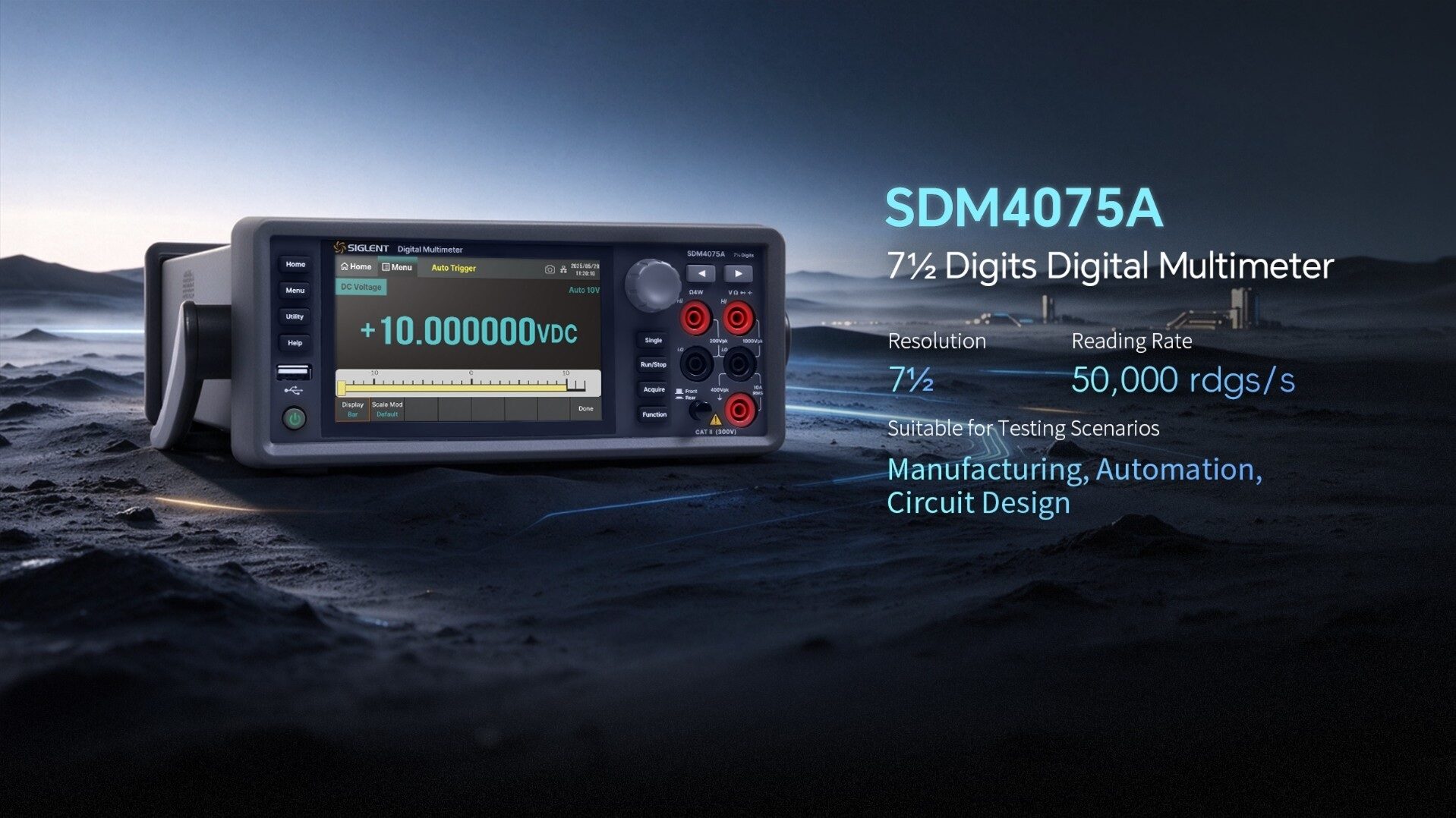
When a small change in voltage or resistance matters, display resolution and measurement setup both become important. The SDM4075A is a 7½-digit digital multimeter with 11,000,000 counts, designed for precision measurements in development, manufacturing and automated test.
Its measurement ranges extend from 100 mV to 1,000 V for DC voltage and from 100 mV to 750 V for AC voltage. DC current ranges from 1 µA to 10 A and resistance ranges from 10 Ω to 1 GΩ are also available, supporting a broad range of bench tasks.
The maximum reading rate is 50,000 readings per second. That headline speed should be considered separately from maximum resolution: integration time changes the balance between speed, noise rejection and measurement performance. A production test looking for a rapid pass/fail decision and a precision investigation of a small drift can therefore call for different settings.
For longer observations, the data logger supports intervals from 0.1 to 3,600 seconds, with up to two million readings stored in memory. Trend, histogram and statistics displays help turn a series of readings into a clearer view of stability and variation. LAN and USB device interfaces support integration into automated measurement workflows.
- 7½-digit resolution and 11,000,000 counts.
- Up to 50,000 readings/s, depending on configuration.
- Data logging, trend and histogram views for observing changes over time.
SYN64-R: distribute synchronisation across a larger test system
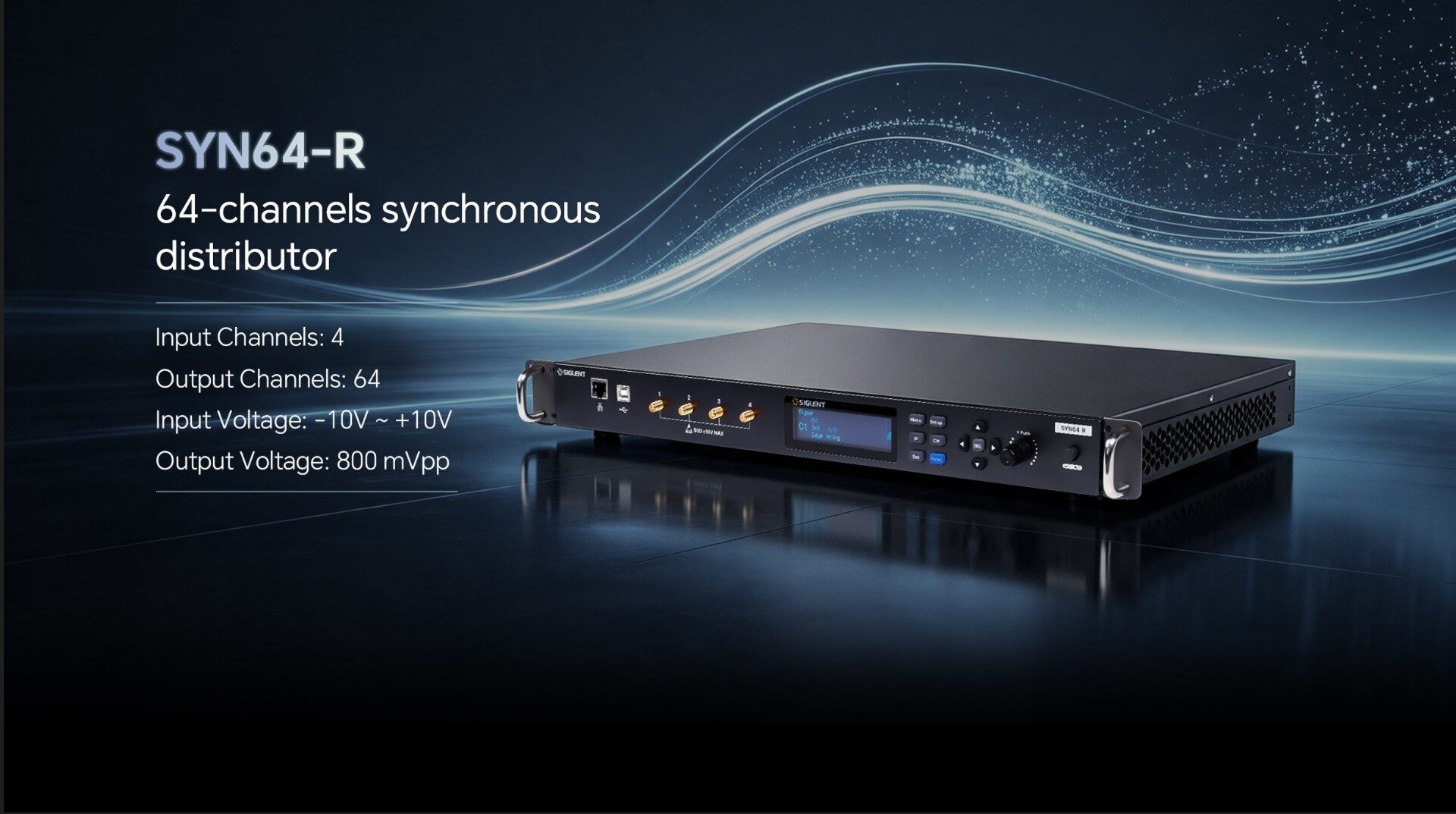
As a measurement system grows, delivering a consistent trigger to multiple instruments becomes a task in its own right. The SYN64-R is a synchronisation distributor with four input channels and 64 outputs, designed to support coordinated acquisition systems.
The outputs are arranged in eight groups of eight. Polarity and delay can be configured independently for each group, helping engineers account for differences in the connected test paths. The datasheet specifies 30 ps typical skew, 50 ps maximum skew and 1 ps typical jitter; the typical figures should not be treated as guaranteed limits.
Inputs accept signals within a −10 V to +10 V voltage range, while the outputs provide an 800 mVpp swing with a 400 mV DC offset into 50 Ω. The distributor supports buffered operation, normal triggering and forced pulse output, with LAN and USB device connections for remote control.
In a multi-oscilloscope system, shared triggering is only part of the timing arrangement. The application diagram separately links instrument reference clocks through their 10 MHz connections. The SYN64-R should therefore be selected as part of a complete synchronisation design, with compatible instruments, cabling and clock distribution considered together.
- 64 outputs in eight independently configurable groups.
- 30 ps typical skew; 50 ps maximum specified skew.
- 800 mVpp output swing into a DC-coupled 50 Ω load.
SAP1000H: probe fast differential signals with less loading
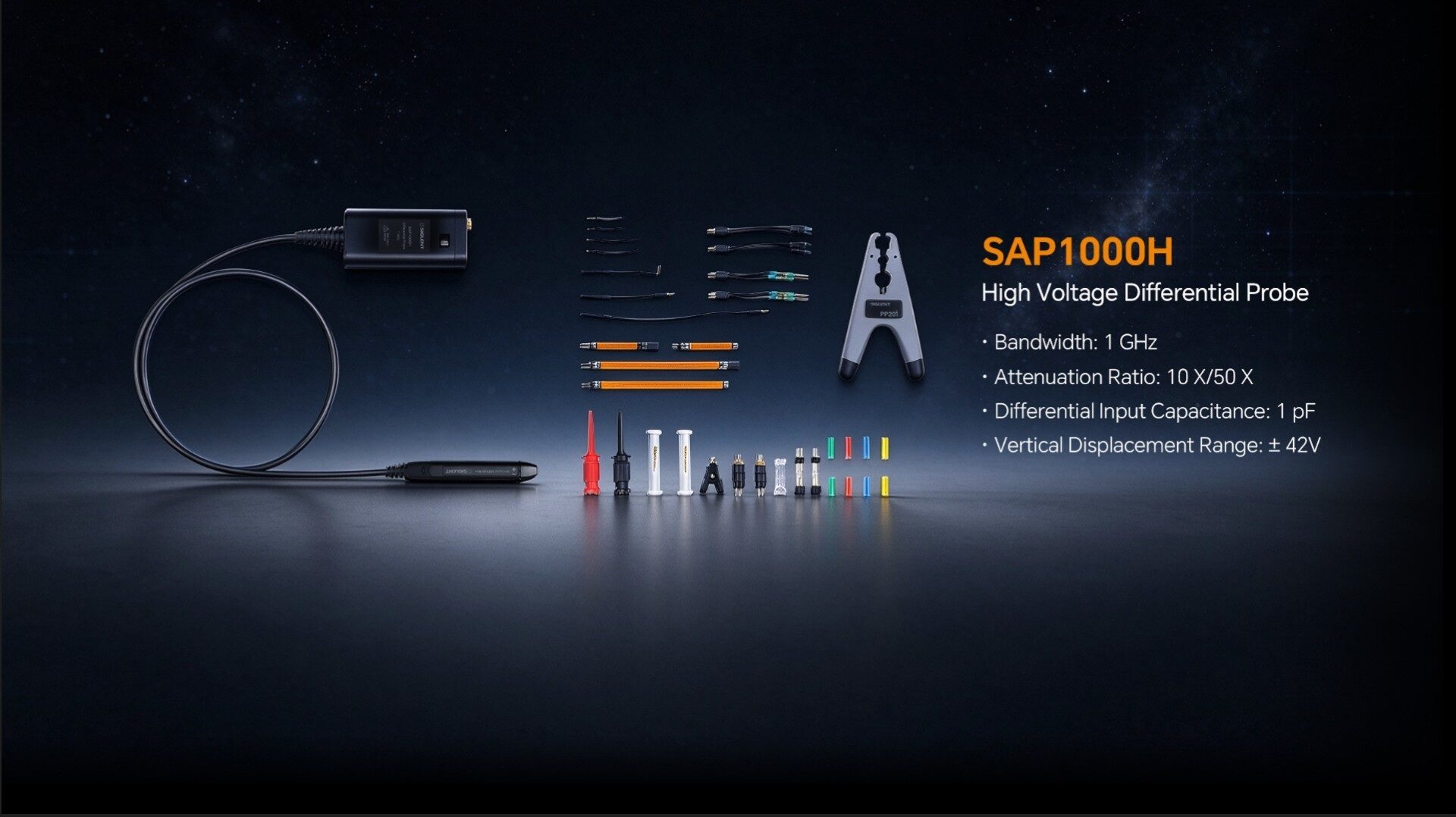
The connection between a circuit and an oscilloscope can affect the waveform being measured. The SAP1000H differential active probe combines 1 GHz probe bandwidth with 1 pF differential input capacitance and 200 kΩ differential input resistance, helping to limit the load placed on the test point.
It offers 10× and 50× attenuation, with an input dynamic range of ±8.4 V at 10× and ±42 V at 50×. The probe connects through SIGLENT’s SAPBus interface, allowing a compatible oscilloscope to supply power and control the probe without a separate battery or power supply.
A selection of tips, leads and adapters supports different test-point arrangements. Connection choice matters: the manual gives different bandwidths for different accessories, so a 1 GHz probe specification does not mean every lead or clip arrangement delivers the same response.
For applications needing more input range, the optional EA0210 attenuator changes the probe configuration to 20×/100× and extends the maximum input dynamic range to ±60 V. Check the manual’s input-to-ground limits and frequency-dependent voltage derating, and confirm oscilloscope compatibility before choosing the setup.
- 1 GHz probe bandwidth and 1 pF differential input capacitance.
- 10×/50× attenuation; ±42 V dynamic range at 50×.
- SAPBus power and control with a compatible SIGLENT oscilloscope.
Which addition fits your next test?
Tell the Telonic team what you need to measure, the instruments you already use and the environment you work in. We can help you check model suitability, software options, probe compatibility and the connections needed for your setup.