 FREE SHIPPING £75+
 CELEBRATING 50+ YEARS
 PRICE MATCH GUARANTEE


Automotive electronics must continue to operate when the vehicle supply voltage falls sharply during engine cranking. This application note shows how to create a representative ISO 16750-2 starting profile using a Siglent SDG6000X arbitrary waveform generator (AWG), a Tekbox TBDCA1 DC-coupled power amplifier and an oscilloscope.
The method converts the required voltage profile into a CSV waveform, imports it through Siglent EasyWaveX and scales it by a factor of ten before amplification. The result is then checked at the equipment under test (EUT), where it matters.
Standards note: this article is a practical implementation guide, not a substitute for the standard. Confirm the required profile, severity level, tolerances and test conditions against the applicable licensed edition of ISO 16750-2 and the EUT test plan.
Why an AWG and DC-coupled amplifier?
ISO 16750-2 and ISO 7637-2 include supply disturbances for automotive electrical and electronic equipment. A cranking profile combines fast voltage transitions, low-voltage dwell periods and a modulated recovery section. Those transitions can be difficult to reproduce accurately with a general-purpose programmable power supply.
Siglent SDG6000X AWG
Generates the programmed, low-level arbitrary waveform from a CSV file.
Tekbox TBDCA1
Provides DC-coupled voltage and current gain so the waveform can drive the EUT supply input.
Digital oscilloscope
Checks the AWG before amplification and validates the waveform at the EUT.
Python and EasyWaveX
Create, inspect and transfer the waveform without manually entering thousands of samples.
The TBDCA1 specification used in the source application note includes 3 MHz power bandwidth, 150 W continuous output power, 300 W peak power, a +/-28 V output range and up to 10 A RMS output current. Always check that the amplifier and its protection limits are suitable for the actual EUT load.
Understanding the cranking waveform
The starting profile begins at the normal battery voltage, falls to a low cranking level, recovers to a modulated supply level and then returns to the initial voltage. The important parameters are the voltage levels, fall and rise times, dwell periods and the frequency and amplitude of the modulated section.
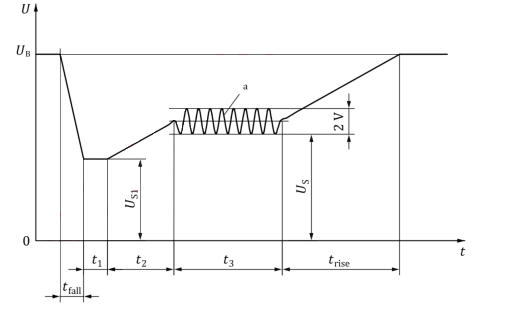
The supplied example is configured around a 12 V, Level II profile. It uses a 10 kHz sample rate and programs the AWG at one tenth of the required EUT voltage. A 20 dB amplifier gain restores the waveform to its intended level.
1. Generate the waveform CSV
The Python script builds each segment separately, concatenates the samples and writes the metadata required by EasyWaveX. The key values are deliberately grouped near the top so the nominal voltage and severity profile can be changed without rewriting the waveform logic.
import numpy as np

SAMPLE_RATE = 10000
FILENAME = "ISO16750-2_cranking_waveform.csv"

# Scaled by 10 for the AWG; the 20 dB amplifier restores the level.
U_B = 1.2
U_S1 = 0.45
U_S = 0.75
U_SINE = 0.1

T_START = 0.050
T_FALL = 0.005
T1 = 0.015
T2 = 0.050
T3 = 10.000
T_RISE = 0.100
T_STOP = 10.000

def points(duration):
    return int(duration * SAMPLE_RATE)

v1 = np.full(points(T_START), U_B)
v2 = np.linspace(U_B, U_S1, points(T_FALL), endpoint=False)
v3 = np.full(points(T1), U_S1)
v4 = np.linspace(U_S1, U_S, points(T2), endpoint=False)

t_sine = np.arange(points(T3)) / SAMPLE_RATE
v5 = U_S - U_SINE * np.sin(2 * np.pi * 2.0 * t_sine)

v6 = np.linspace(U_S, U_B, points(T_RISE), endpoint=False)
v7 = np.full(points(T_STOP), U_B)

v_total = np.concatenate([v1, v2, v3, v4, v5, v6, v7])
t_total = np.arange(len(v_total)) / SAMPLE_RATE

v_max = np.max(v_total)
v_min = np.min(v_total)
amplitude = v_max - v_min
offset = (v_max + v_min) / 2.0
base_frequency = 1.0 / (len(v_total) / SAMPLE_RATE)

with open(FILENAME, "w", newline="\n", encoding="utf-8") as file:
    file.write(f"data length,{len(v_total)}\n")
    file.write(f"frequency,{base_frequency:.6f}\n")
    file.write(f"amp,{amplitude:.6f}\n")
    file.write(f"offset,{offset:.6f}\n")
    file.write("Second,Volt\n")

    for time, voltage in zip(t_total, v_total):
        file.write(f"{time:.6f},{voltage:.6f}\n")

print(f"Created {FILENAME} with {len(v_total)} samples")
With the values above, the complete record is 20.22 seconds long. The sine term has a 0.1 V peak amplitude at the AWG, equivalent to 0.2 V peak-to-peak before the x10 amplification.
2. Import and inspect the waveform in EasyWaveX
- Run the script to create the CSV file.
- Open EasyWaveX and import the CSV.
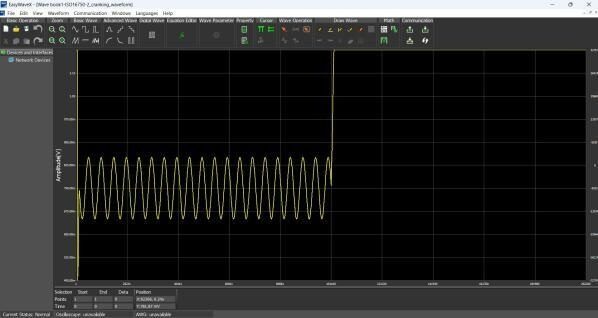
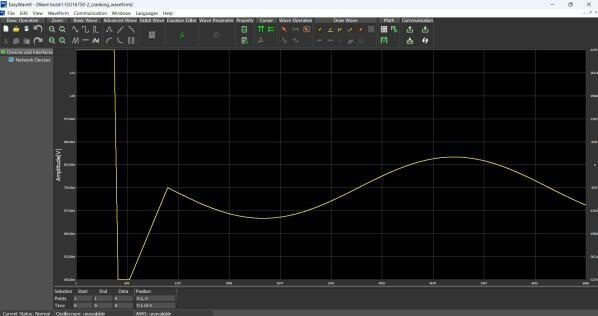
- Inspect the complete record for discontinuities or an unexpected final transition.
- Zoom into the initial voltage drop and the modulated section.
- Transfer the waveform directly to the AWG over USB, or export it as a binary waveform and load it from a USB drive.
3. Set the AWG amplitude and offset
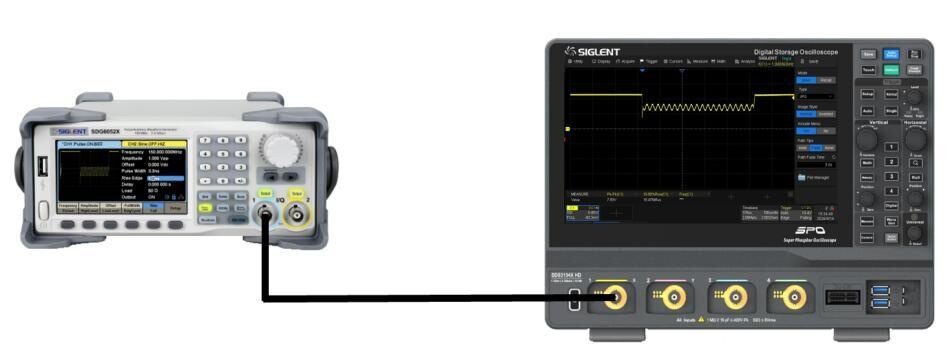
Calibrate the low-level signal before connecting the TBDCA1 or the EUT. Connect the AWG directly to an oscilloscope, enable the output and check both the maximum and minimum voltage.
| Example setting | AWG target | After 20 dB gain |
|---|---|---|
| Maximum voltage | 1.2 V | 12 V |
| Minimum voltage | 0.45 V | 4.5 V |
| Programmed range | 0.75 V peak-to-peak | 7.5 V peak-to-peak |
Set the AWG amplitude to reproduce the programmed range, then adjust the offset until the waveform maximum reaches 1.2 V. Confirm the termination setting used by the AWG and oscilloscope; a 50 ohm/High-Z mismatch can change the displayed amplitude.
4. Connect the TBDCA1 and EUT
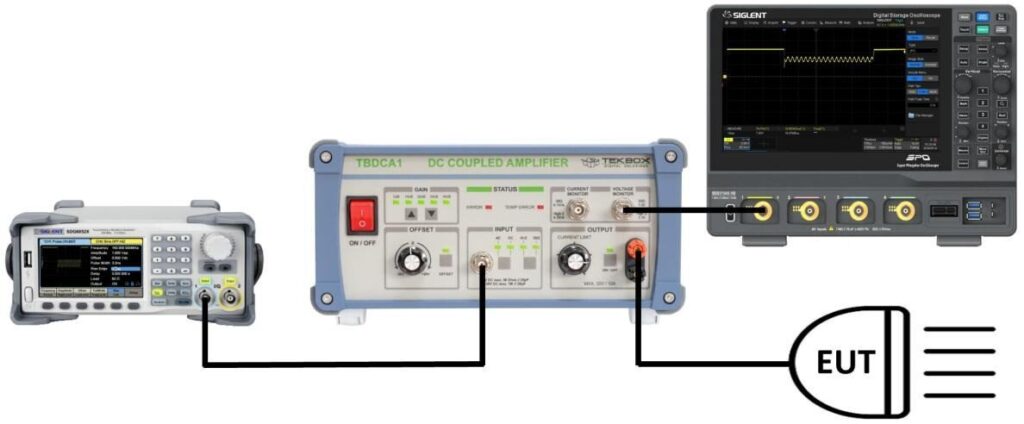
Disable the AWG output before changing the wiring. Connect the AWG to the TBDCA1 input and connect the amplifier output to the EUT supply input. Use the TBDCA1 voltage monitor output for the oscilloscope measurement.
- Keep the AWG output disabled while completing the connections.
- Set the TBDCA1 input to DC coupling and High Impedance.
- Set the TBDCA1 gain to 20 dB.
- Set the oscilloscope channel to a 1:10 ratio to compensate for the voltage monitor output division.
- Switch on the amplifier, connect the EUT and enable the amplifier output.
- Enable the AWG output and verify the actual voltage at the EUT before assessing its functional behaviour.
5. Validate the waveform at the load
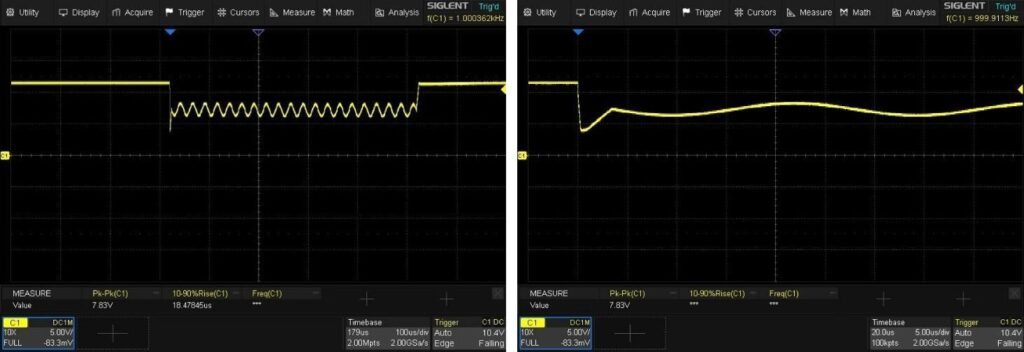
The final check must be made with the EUT connected. Load current, cabling, protection behaviour and amplifier limits can all alter the waveform delivered to the product. Capture the complete event and then zoom into the fast transitions and modulated section.
What to record
- Actual voltage levels at each stage of the profile
- Fall time, rise time and dwell durations
- Frequency and amplitude of the modulated section
- Any current limiting, clipping or amplifier protection event
- EUT resets, communication errors, diagnostic flags or degraded operation
- Instrument settings, software version, waveform file revision and EUT configuration
A correctly shaped waveform at the AWG is only the starting point. The compliance evidence is the waveform measured at the loaded EUT supply terminals, together with the EUT functional result.
Practical checks before testing
- Confirm the selected profile and severity level against the applicable test plan.
- Check the EUT inrush and operating current against the amplifier’s continuous and peak ratings.
- Use short, adequately rated leads to minimise voltage drop and unintended inductance.
- Confirm oscilloscope input scaling and probe attenuation before recording results.
- Begin without the EUT attached and enable each stage in a controlled sequence.
- Provide a safe method to disconnect power if the EUT or amplifier behaves unexpectedly.
Relevant equipment and categories
The original setup uses the SDG6000X family. The product cards below provide current Telonic options; the category links help select an oscilloscope and explore suitable amplification.
-
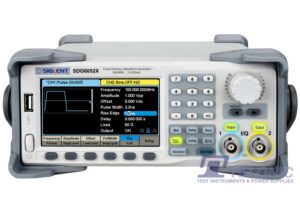
Siglent SDG6022X 2Ch, 200MHz, 2.4GSa/s, Function Generator
£1,103.00 (£1,323.60 inc. VAT)4 in stock (can be backordered)
Availability: Stock models delivered next working day (UK only) for orders placed before 16:30 (Mon - Fri)
Add to basket -
Siglent SDG6032X 2Ch, 350MHz, 2.4GSa/s, Function Generator
£2,494.00 (£2,992.80 inc. VAT)1 in stock (can be backordered)
Availability: Stock models delivered next working day (UK only) for orders placed before 16:30 (Mon - Fri)
Add to basket -
Siglent SDG6052X 2Ch, 500MHz, 2.4GSa/s, Function Generator
£3,893.00 (£4,671.60 inc. VAT)Available on back-order
Availability: Stock models delivered next working day (UK only) for orders placed before 16:30 (Mon - Fri)
Add to basket
Source: practical method and figures adapted from the Tekbox application note “Creation of ISO 16750-2 waveforms with Siglent AWG and Tekbox TBDCA1”, version 1.0.